Location no problem for Watauga High School
Since college recruiting is an ongoing process and large division one schools consistently have recruiters visiting large high schools to see the best talent, it can be easy to assume that a small community like Watauga County with only one high school may get overlooked.
According to Watauga high school baseball head coach David Lee, if a player can play at the next level, location means nothing and a recruiter will find the athlete, see him in person and proceed from there.
“If the coach is super interested, they are going to come see the kid play in person,” said Lee. “They want to watch him in a game at his high school, and they might bring him on campus to have him play a little bit or swing the bat.”
For the coach to become interested enough to see the player in person, the athlete must first get on the coach’s radar. The easiest way for that to happen is for the player to frequently make it into the local paper.
When that happens and the player shows interest in playing at the next level, the athlete needs to further put his/her name in the mix. That could be anything from sending an email to someone within the colleges athletic department, to attending a camp held at the school, or even sending video to a scout.
If a player impresses the coach of the team that the athlete wants to play for, then recruiters will try to see if the player should be recruited further. Distance has little effect on if that player is recruited or not when the coach wants the player to play for him.
Talent trumps travel, and when a coach is seriously recruiting a player, the coach begins to look at that player’s attitude, character traits and how the player acts around those he/she sees every day.
“When recruiting a high school athlete in a small community like Watauga I think that can sometimes help the recruiters because it is easier to get to know the kid and the coaches,” said Watauga High School Girls Basketball Coach Laura Barry.
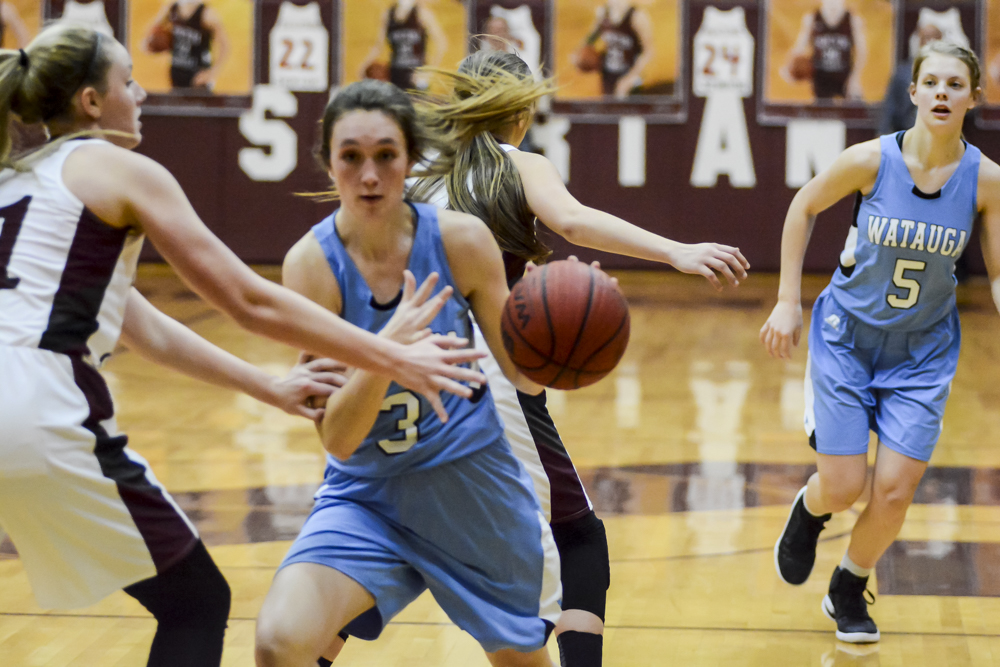
Olivia Williams drives to the basket in an away game last week. Photo: David Rogers
Barry also said that larger universities will recruit at larger schools because they typically have a larger talent pool, and because the smaller universities normally cannot draw those top tier athletes from larger schools, they will stick closer to home and in smaller communities.
While it is clear that larger universities travel makes little difference to whom they recruit, and smaller universities will stay closer to their area, that process is not always the same for every sport.
“It is difficult because of where we are at but it is difficult in general anymore and part of that is because of AAU (Amateur Athletic Union),” said Watauga Head Basketball Coach Rob Sanders, talking about how basketball now has a different cycle for finding talent at the high school age.
“It is a lot easier for a coach to go to AAU tournaments in July where he can see 50 kids instead of coming up here to see just one. It has taken a lot of importance away from what we are doing in getting them ready for the next level and handed it over to AAU.”
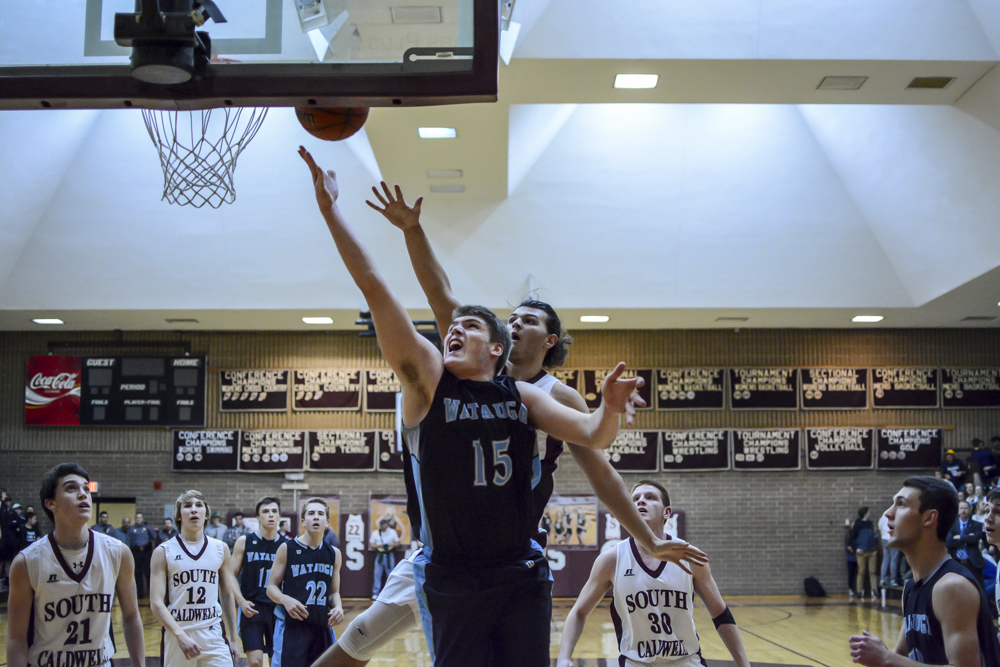
Senior Alex Mcconnell ducks in for a layup last week vs South Caldwell. Photo: David Rogers
Unlike sports such as football, baseball, volleyball and wrestling, basketball’s summer leagues like AAU have become a popular place for college coaches to go see multiple recruits at the same time.
Seeing coaches at high school basketball games has become less and less frequent as AAU’s popularity has grown and that is hurting more than just smaller schools like Watauga.
While this problem goes deeper, the surface of the issue gives perspective on the caveats of high school recruiting. The other major sports that recruiters find players in have not had this kind of issue yet, and for the time being, will continue to see coaches and recruiters at their games to see athletes.
Because distance or size of school seldom deters a coach from finding talent, schools like Watauga and athletes that attend those schools, have little to worry about when they begin their search for potential universities to attend.
Barry, who coached at East Tennessee State University before coming to Watauga, has been a part of recruiting athletes before, and stated that because fit and culture do make a big difference in if that player is recruited that sometimes non-division one schools will look to the smaller communities to find their athletes.
All photos taken by David Rogers of The Blowing Rock News